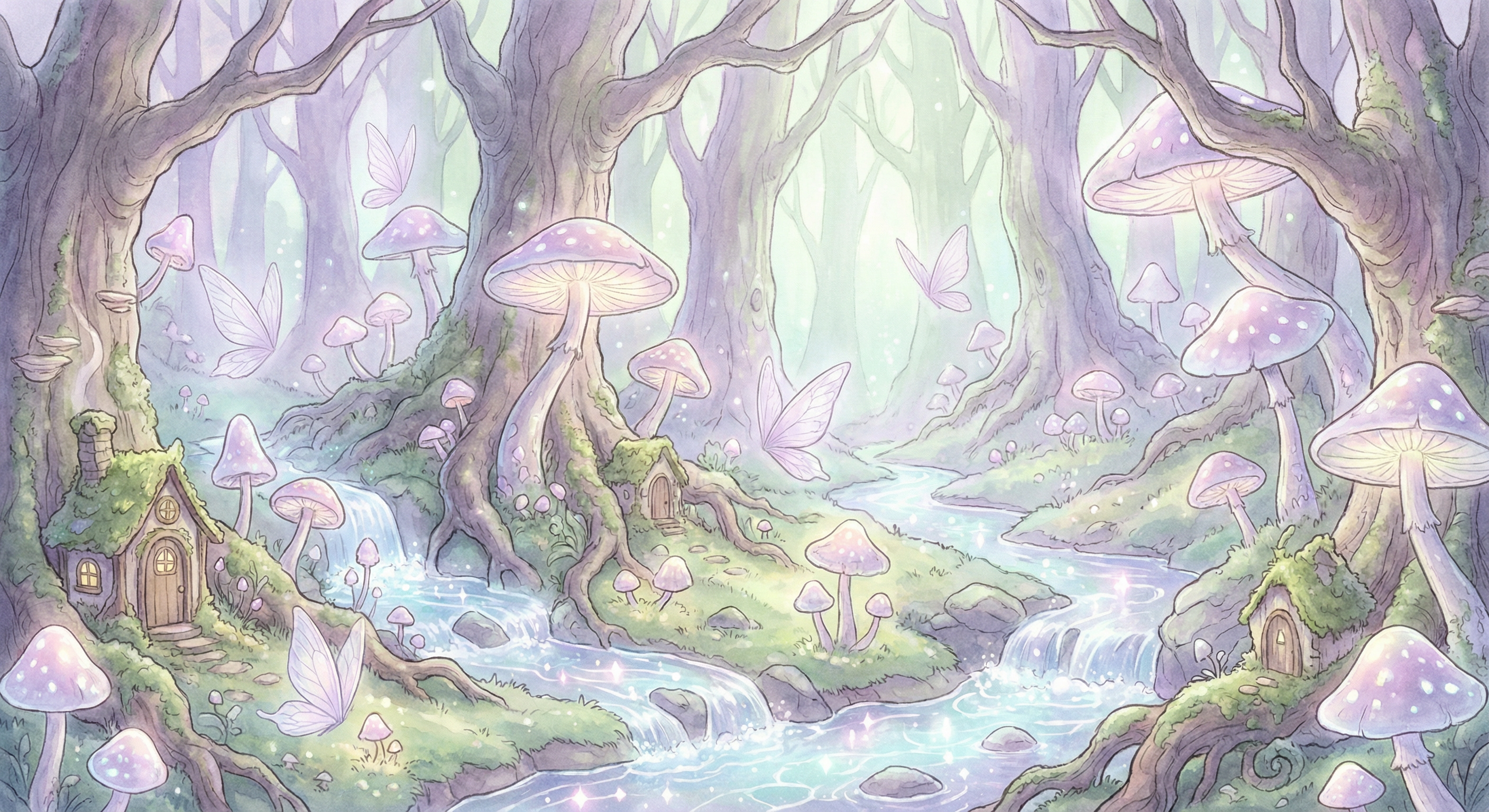
A parallel world
The realm of fairies is not a geographical place we can point to on a map. It is a dimension that coexists with ours, visible only to those with the gift of "second sight" or at moments of transition: at dawn, at dusk, on full moon nights, at the solstices (especially Beltane and Samhain), or in the thin places where the veil between worlds grows fragile.
Some scholars suggest that the faerie realm represents the human psyche's need to give form to the unknown—to the wild and untamed aspects of nature that resist rational explanation. Others believe it is a literal dimension, accessible through altered states of consciousness, near-death experiences, or in liminal spaces. Whatever the truth, the idea of a world just beyond our perception has captured the human imagination for millennia.
Places of entry: portals to the Otherworld
According to tradition, certain natural locations serve as gates between our world and the faerie realm:
🍄 Forest clearings and fairy rings
Circular formations of mushrooms, darker grass, or flowers are said to mark where fairies have danced. These "fairy rings" or "elf circles" are among the most famous portals. Entering one can mean being drawn into an endless dance—what feels like minutes might be years in the human world. Some traditions hold that fairy rings bring good luck if you pass through them; others warn that they are traps. The variation reflects the fairies' own ambivalent nature.
💧 Springs, wells, and bodies of water
Water that emerges from the earth—springs, sacred wells, the meeting of two streams—has long been considered a threshold between worlds. Many legends tell of fairies emerging from lakes, pools, and waterfalls. In Celtic tradition, certain wells were so sacred that gifts were left at their edges. The Lady of the Lake, who gave Arthur Excalibur, is one of many water-dwelling faerie figures. To look into such waters at the wrong moment, it is said, is to risk being pulled in.
⛰️ Hills and mounds (sídhe)
In Ireland and Scotland, artificial hills and ancient burial mounds—the sídhe—are believed to be the dwelling places of the faerie folk. The Tuatha Dé Danann, the old gods of Ireland, were said to have retreated into these mounds when the Milesians arrived. On Beltane (May 1) and Samhain (November 1), the doors of the sídhe open, and the fairies ride forth. It was considered extremely dangerous to disturb a fairy mound; those who did might be cursed or abducted.
The nature of faerie time
One of the most consistent features of the faerie realm is that time passes differently there. A night spent in fairyland might equal seven years—or seven generations—in the human world. This is why legends universally warn against eating or drinking what the fairies offer: to consume their food is to be bound to their realm and their time. Those who return often find that everyone they knew has aged or died. This theme speaks to the disorientation of encountering the numinous—the sense that ordinary reality has been suspended.
Beauty and danger
The faerie realm is typically described as a place of overwhelming beauty: gardens in eternal bloom, rivers of silver and gold, trees that sing, skies of perpetual twilight. But it also has its perils. Labyrinths from which there is no exit. Dances that never end. Beautiful people who reveal horrifying faces. The fairies themselves can be generous or cruel, and their moods shift like the wind. To enter their realm is to accept that the rules of human society no longer apply.